
I wanted to like “Ha-Chan, Shake Your Booty!” I really did. After all, it’s a Sundance success story — a little indie in the Dramatic Competition category that lined up a major distribution deal with Sony Pictures Classics just before the festival closed — and the buzz has been solid. It’s also the kind of movie I usually love — about a diaspora I know nothing about, but which writer/director Josef Kubota Wladyka knows intimately.
Wladyka is an at times excellent filmmaker and television director whose own background is that he’s the American son of a Japanese mom and a Polish dad. His protagonist Haru (aka Ha-Chan) is based on his own mother. Wladyka has also spent considerable time filming in Latin America — his audacious film debut “Manos Sucias/Dirty Hands” was a low budget “Sicario” boldly shot on location in Columbia. Who better to tell a story grounded in the Latin Ballroom Dancing scene of Tokyo?
Here’s the problem: After sitting through “Ha-Chan,” I still know nothing at all about the milieu, including whether or not it actually exists. Is there a Latin ballroom scene in Tokyo? And if there is, can it be as wan and vaporous as what’s onscreen here? I can’t tell. The world Wladyka’s chosen to chronicle doesn’t anchor itself to anything that feels like actual details — the stray insights built from social and environmental texture you can glean from almost any international movie (even a bad one) never materialize here. It’s a small bone to pick, but just as an example: Wladyka’s protagonist Haru lives in a gorgeous multi-chambered Tokyo home, furnished lavishly and with an entire wall comprised of vinyl record albums, arranged around a turntable centered like the tabernacle in a church. An impression of enormous generic middle class comfort is conveyed. But nobody in Haru’s life seems to have a job, and she herself never goes to work.
So detail is replaced by what? Not a formula exactly, although this is definitely a genre exercise — a romantic comedy-drama modern viewers of a certain age might associate with 1998’s similarly titled “How Stella Got Her Groove Back,” wherein Angela Bassett learned to live again via a series of Jamaican hook-ups with a moist young Taye Diggs. Conceptually if not tonally, “Ha Chan” resembles a much older movie even moreso — 1961’s “The Roman Spring of Mrs. Stone, ” from the novel by Tennessee Williams, featuring Warren Beatty as a rent boy paired with aging actress Vivien Leigh (look them up, children, all three were giants once upon a time). Spoilers follow.
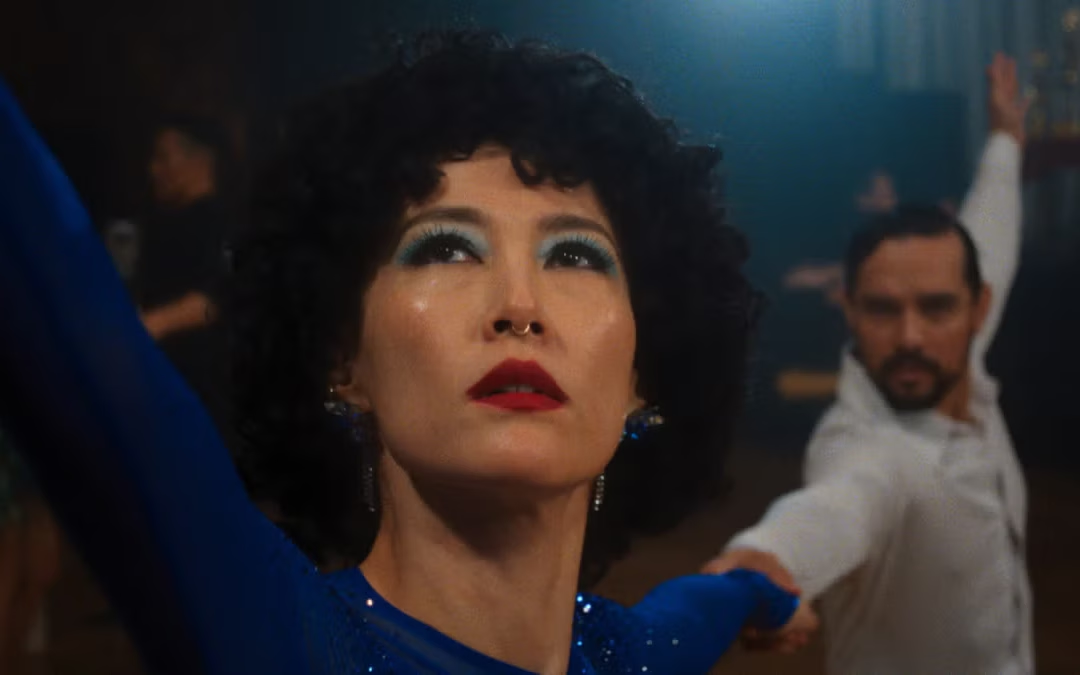
Like Leigh’s Mrs. Stone, Haru’s (Rinko Kikuchi) cossetted life is upended by an unexpected tragedy: the sudden death of her spouse. Haru’s husband Luis (Alejandro Edda) is also her Latin dance partner. That is until he drops dead in the middle of their first number during a big ballroom competition. Haru is understandably distraught, and Wladyka opts for magical realism in dramatizing her predicament. When she wants to retreat from life, Luis reincarnates in her lucid dreams as a large black bird with a ratio. He’s 50 percent NFL mascot, 50 percent Disneyland “cast member,” and wholly WTF?
Haru is shaken from her torpor by her meek sister Yuki (Yoh Yoshida) and her wildish cousin Hiromi, played by the astonishingly annoying Yukiko Ehara aka You. Hiromi is closer to the brash donkey Eddie Murphy voices in “Shrek” movies than to anything resembling a human, and Ehara turns everything up to eleven from the minute we meet her, and then decides to go for 13. It’s fitting the film’s title comes from one of Hiromi’s lines of dialogue, because Hiromi embodies overtly the subtle problem of “Ha-Chan.” There’s a level of glib to this film approaching fraudulence, playing out in an intriguing setting that doesn’t seem to interest the filmmakers very much at all. If you’re interested in Japan, you’ll almost want the people to get out of the way.
Of course Haru falls head over heels in lust with her dance instructor, the hunky and graceful Fedir (Alberto Guerra). He’s a former “Dancing With The Stars” competition partner, poetical in the way movie Latins have been since the MGM days of Ricardo Montalban. And he’s married, although that’s not really a complication — until it needs to be. But will great sex — and repetitively staged dance fantasies — be enough to help Haru shake her booty back?
It isn’t fun to dislike a movie when it wants to be liked so very badly — for all it’s chocolate heart sentimentality, I get the feeling “Ha-Chan” is sincere. That isn’t to say there isn’t a lot of Sundance calculation at work here though. That big black bird Luis manifests (accompanied by its own eerie tone) sure feels a lot like the Rabbit from Sundance breakout “Donnie Darko” at times. Meanwhile, the big dance numbers in Haru’s daydreams have almost certainly seen “500 Days of Summer” more than once. Maybe even during its smash 2009 premiere — at Sundance.
In the thriller format, Wladyka has proven a potent filmmaker, but he has no real feeling for dance. The go to is steadicamming around the dancers in a half-to-three-quarters circle, a visual cliche used so often I stopped being able to see anything but the camera choices after awhile, whenever that shot came around. The cinematography by Daniel Satinoff is let’s just say unobtrusive; the run time a little long.
Principle performers run the gamut from good (Alberto Guerra) to very good indeed (Rinko Kikuchi). Kikuchi in particular feels like a slightly missed opportunity, because she’s ready to commit to anything asked of her, absolutely. So you keep waiting for that big scene about grief and life and all the major emotional touchstones “Ha-Chan” tiptoes up to, but doesn’t have the confidence to truly address. Instead, “Ha-Chan” layers bedroom farce on top of the whimsy, growing uncomfortably stalkerish by the middle of act three.
I feel bad writing all that, because Wladyka is consciously stretching here, and that is laudable. It’s also touching when a youngish creator swings for the fences, and youthful enthusiasm is always an energy. But twee mannerisms are an avoidance strategy — not just for Haru but for “Ha-chan” itself. It’s a film about loss that doesn’t really take loss seriously, except as what film schools call the “inciting incident” for a bunch of half-realized indie mannerisms.
Still, I hope the world disagrees a little when “Ha-chan” hits the marketplace. It didn’t speak to me much at all, but who knows? Arthouse audiences looking for something light might love it.