
(IMAGE: Warner Bros.)
Warner Bros. 2025. Mystery & Thriller/ Action/ Comedy. 161 minutes.
RATING: 4 out of 4
Paul Thomas Anderson’s chaos opera One Battle After Another is the only movie you’ll see this year that feels like America.
That’s both a sign of greatness and not entirely a good thing. Because have you seen America lately? It’s a mess, and everyone adrift in this leaky lifeboat nation knows it. They go to bed scared and lost, and wake up partially digested, inside the belly of an undulating gila monster of seething sectarianism, ideological anger, openly expressed bigotry, violence that’s both rhetorical and actual, and sound bite putdown insult comic journalism, all tethered to daily acts of official governmental cruelty and paramilitary chest-thumping that just two short years ago would have seemed unimaginable.
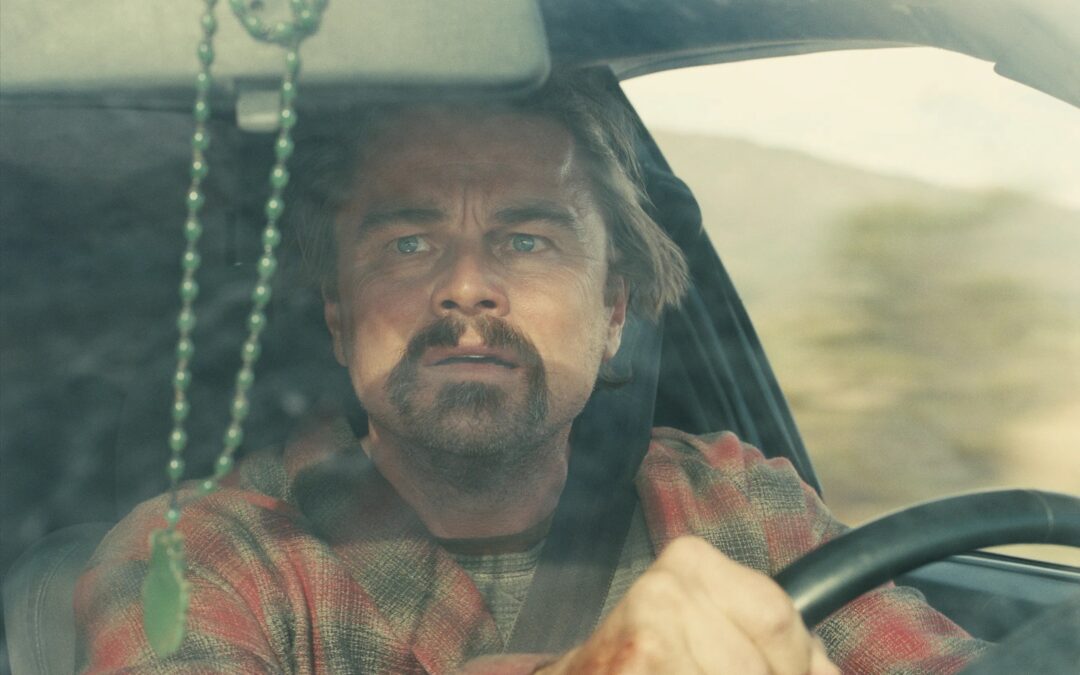
Into the scalding cauldron of our times strides the master filmmaker of this generation, unscorched by the heat, and bearing gifts: a roiling ideological Roadrunner cartoon, that pits left and right against each other in a deadly but farcical faceoff created to solve nothing, except by making us see ourselves a bit clearer. The emblems of that left/right schism are played by Leonardo DiCaprio and Sean Penn, as “Bob Ferguson” and Col. Steven J. Lockjaw. “Bob” is a retired revolutionary and sloganeer in the style of the Weather Underground; Lockjaw a repressed and tormented military man, whose sole ambition in life is to be admitted into the secret society of the Christmas Adventurers Club, where soft-shoe white supremacism, avaricious affluence, and homicidal Christian nationalism hold hands and square dance.
The face-off between “Bob” and Lockjaw is complicated because they have a past, in the form of the aptly named Perfidia (a ferocious Teyana Taylor), “Bob”‘s love partner in old and violent crimes, and the shapeshifting seducer of Lockjaw during an immigrant liberation operation “Bob” and Perfidia once pulled off at the border. “Willa” (radiantly played by Chase Infiniti) is the child Perfidia abandoned when she got caught during a murderous bank robbery and ratted out everyone she knew. At 16, “Willa” could be the biological daughter to either man, and she’s what “Bob” and Lockjaw are fighting over, not some higher ideal they each might kid themselves they stand for. In the world of this movie, politics are a scam.
Our yammering and doctrinal media has decided to label the film as woke, presumably because Leonardo DiCaprio plays the militant, and hey, he played Jack in Titanic, ‘member? So he must be the hero. But Anderson’s scorn covers the ideological landscape from sea to shining sea. In a career of playing fascinatingly weak men, DiCaprio tops himself with the most ineffectual radical the movies have seen, and the feeblest character he’s ever played. Ostensibly “Willa’s” rescuer, “Bob” does little but flee, tumble and smoke weed, and he spends the entire final half of the movie — even while on the run — in a dirty bathrobe. Meanwhile, Penn’s Lockjaw is a twitching, grunting, limping morass of psychotic mannerisms, who would border on parody if he wasn’t rendered entirely human by the low animal fear caroming around inside Lockjaw’s untethered eyes.
I adore Paul Thomas Anderson’s work, but I am at a loss to describe fully how he gets his effects. This movie is pure forward momentum — it hurtles, it plummets, and it always feels like it’s taking place in a heightened present tense. I can see that Anderson is the heir to a Robert Altman-style of improvised performance, and that it makes his actors seem similarly alive. I know he favors wide angle lenses where Altman preferred long ones. I know he uses music as a form of abrasion, in a way that comes down to him (and to Quentin Tarantino) from Kenneth Anger movies, by way of Martin Scorsese. After that, I don’t know what to tell you. I am always too pulled in by this maestro of American carnage to truly analyze his work. And I think I refuse to go there, because I don’t want to risk causing the spell to break.
I do know that Anderson is the only contemporary moviemaker consistently working on a canvas big enough to house the semi-sane half-mirage that is today’s America. The immigration raids L.A. just lived through are mirrored in political street violence Lockjaw promotes just so he can be the hero who put it down. But we don’t see all that much in the way of street level struggle. It’s smoke and firelight discharging just offscreen, like the French Revolution in a Broadway production of Les Miz — a theatrical effect, with almost no impact on the clutzy blindfolded cat and mouse game at center screen. And that’s intentional, because these characters aren’t built out to be movie protagonists, they’re just human beings in the grip of stupid ideas, and they live in the same terrified relationship to the “larger forces at work” the rest of us currently occupy.
The one truly dangerous proposition in OBAA is that it fantasizes into existence a believable and semi-organized anarchist underground, engaged in a blood ballet with forces of reaction that are no less caricatured but far more recognizable as emblems of our time. One can almost imagine Donald Trump accidentally seeing the film, and then launching the National Guard against Warner Bros.
But that isn’t a problem with this movie that sees around corners. It’s the problem of our complex and scarifying times. That somebody just made a masterpiece capable of housing all that might be the only cause for optimism you’ll encounter this calendar year.
###