
(IMAGE: 20th Century Studios)
20th Century Studios. 2025. Biography/Drama/Music. 120 minutes.
RATING: 2 out of 4
(This review contains spoilers.)
Few but the diehards realize Bruce Springsteen’s career has been carefully managed for decades by a once-celebrated rock critic named Jon Landau. After seeing Springsteen play a small venue in 1974, Landau famously (and portentously) said, “I have seen rock and roll’s future, and its name is Bruce Springsteen.” Landau moved into the producer’s chair after that widely quoted rave, co-creating what became Springsteen’s breakthrough 1975 album “Born to Run,” which lent a self-conscious and commercially triumphant Phil Spector sheen to a critical darling previously described as both “low-selling” and “Dylan-esque.”
Landau was running Springsteen’s career by the end of those sessions, though it took a bitter legal battle with Springsteen’s original manager Mike Appel to make Landau’s title official. When Springsteen testified against Appel in court, he said the disadvantageous contracts Appel had him sign were bad enough. But worse was how Appel was inhibiting his larger project in ways Landau would not. “More than rich, more than successful, more than happy, I wanted to be great,” Springsteen has said of that era. And Landau, one of rock’s most prominent arbiters of what constituted “greatness” in the pre-punk 1970s, was the man to help him do it.
A large part of that process has been about building and then maintaining the Springsteen narrative. Poet laureate of the working man. Bard of Atlantic City, New Jersey. Troubadour of everything repressed and withheld in the furtive, broken and only occasionally triumphal storylines lived out by American lives.
It helps that at his best, Springsteen has the goods. He’s hardworking: even as he nears 80, his epic shows can still run three hours without interruption. He’s a limited but rowdy guitarist, in a medium cherishing limitation and rowdiness over virtuosity. And he’s a frequently expressive songwriter. The change in his writing style from the headrush logorrhea Dylanisms of the “Rosalita” era to the hard, dark literary tale-telling begun with “Darkness on the Edge of Town” has been attributed to Landau’s influence, in particular Landau’s gifting Springsteen with a book of stories by that black comic of Catholic Guilt Syndrome, Flannery O’Connor.
But as a lapsed fan who still admires much of Springsteen’s output, I have to say what drove me away was a growing sense it was all just a little too calculated. They’re all concept albums for one thing — and not just the obvious ones like “Pete Seeger Sessions” and “Western Stars.” “Born to Run” is the epic Leonard Bernstein street ballet. “Darkness on the Edge of Town” is the downbeat shadow cast by all that “Born to Run” sheen. “The River” is perhaps the best appropriation of the punk back-to-basic ethos by any mainstream rockist, announced not just in the guitars-forward production but in a dayglow cover font recalling “London Calling.” In its own way, Springsteen’s creative output is more driven by a kind of military pre-planning than “Sgt. Pepper’s Lonely Hearts Club Band.”
When 9/11 happened, Springsteen gave us “The Rising,” his multi-pronged portrait of a city and a country in grief. A lot of it was moving and beautiful, and “You’re Missing,” his contemplation of the everyday objects that flay us when someone we love is suddenly gone, still makes me cry. But when people said “Bruce did this because he had to,” you kind of felt like that might not be a compliment. Almost every creation seems fed by self-curation, and we were always asked by the fawning old guard rock press Jon Landau helped found to embrace Bruce as the embodiment of the bohemian “magic that can set you free,” when what came through if you listened hard was a control freak, writing to a sense of legacy, from a self-abnegating posture barely disguising an encroaching self-importance.
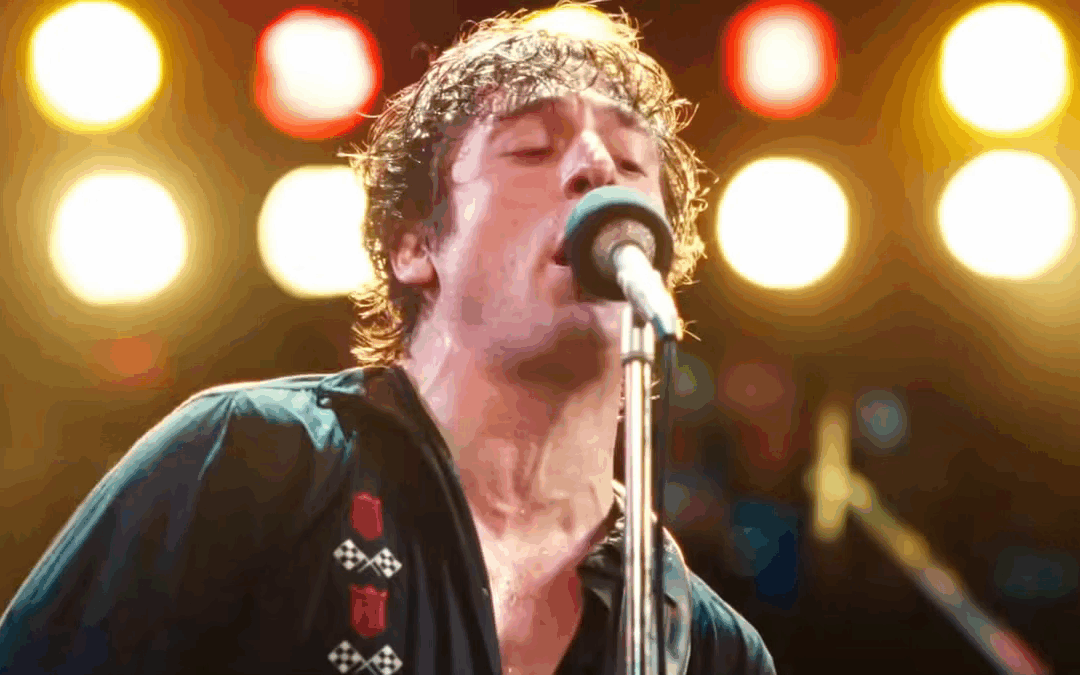
That feeling rose in my throat with a vengeance watching “Springsteen: Deliver Me From Nowhere,” Scott Cooper’s new anti-biopic about a dark night of the soul Springsteen (Jeremy Allen White) experienced when, as the film inaccurately suggests, he broke through commercially with the single “Hungry Heart” in 1981. (In the real world, “Born to Run” went to number three and landed Springsteen simultaneously on the covers of Time and Newsweek, an unprecedented feat for a figure from the arts; the 1978 follow up album “Darkness on the Edge of Town” went to number 5.) Based on the book by Warren Zane, Cooper’s film focuses tightly on the creation of a single record: the spooky lo-fi masterwork “Nebraska,” recorded as home demos and released as is when Springsteen couldn’t replicate the scarifying sound of his bedroom in the studio for his dark tales of mass killers, petty criminals, and blue collar day workers living half a paycheck from catastrophe.
A centerpiece of the album, and the one truly autobiographical song aside from its companion track “Mansion on the Hill,” is called “My Father’s House,” and it’s about how in his moment of crisis Springsteen was haunted by memories of his brutish and mentally ill father’s failed life. The paternal relationship is focused on in flashback by “Deliver Me From Nowhere,” and much of the most impactful material deals with how the dull thud of an abusive parent’s footfall can echo for decades in their children’s lives.
The Springsteen depicted here is leaving his New Jersey past behind whether he wants to or not, because fame and money have their own dictats. It’s suggested, rather too simply, he’s being pushed toward something he doesn’t want. But if you listen to “Hungry Heart,” the top ten single the film presents as a kind of unhappy commercial accident, you’ll hear the sound of a man striving for a hit. The voice is virtually unrecognizable — who knew Springsteen’s razorblade throat could croon? — and every single word is articulated cleanly for maximal radio friendliness. And as to not wanting the trappings of fame: within two years of “Nebraska’s” release, Springsteen would be engaged to a super-model. Almost exactly forty years after the “Nebraska” sessions, he’d sell off his publishing, including “Nebraska” and everything on it, for a still-record $500 million. Two years after that unimaginable payday, Bruce’s blue collar fans would be protesting about paying up to $5000.00 a ticket for his latest shows, with all that bank earmarked, via “dynamic pricing,” for Bruce and his E Street Band.
The cheat at the heart of this movie is embodied in a fictional character, a single mom named Faye, played by Odessa Young with the chirpiness of Donna Reed as a housewife on 1950s television. Faye is a waitress, living the kind of thwarted life Springsteen the writer poeticizes, though the film never makes the link — the kid sister of an unnamed pal from the neighborhood who gets pushed onto Springsteen outside a club after he holes up in a downscale New Jersey rental house to recover his creative spark. Young is appealing, and she’s trying so hard. But she’s been directed to play only a carefully modulated range of emotions, lest Jeremy Allen White’s blankly traumatized Springsteen get judged harshly for treating her poorly in the name of his art.
Faye could have been a symbol of the community Springsteen came from and how it fed his work, and turning away from her could have been explored as leaving something larger and more precious than a relationship. It isn’t, because Landau (portrayed as a kind of zen Jiminy Cricket by Jeremy Bret) continues to promulgate an official narrative even now that Gazillionaire Bruce still has the common touch. So Faye’s never allowed to be so much as mildly impressed by fame, except to acknowledge it exists as a concept, and she’s never allowed to get truly angry, even when Springsteen stands her up on a date that includes her toddler daughter, which made me want to spit fire. Faye is by design a cypher, allowed only the emotions needed to feed the legend without providing dissonance within it — a central character, hidden from view.
In the third act, it’s revealed we’ve been watching a full mental breakdown, as Springsteen’s fight to release his album the way he wants to culminates in catatonia and a suicidality that’s never acted upon, and only obliquely expressed. Jeremy Allen White gets the Oscar clip he came for, via a “brave revelation” of the kind usually reserved to the chat shows. Still, it’s a good thing when famous people destigmatize mental health issues, and Jeremy Allen White does an especially fine job when given something challenging to enact.
But even in this moment of raw revelation, I couldn’t wash away the impression from watching White and Springsteen do every TV interview for the film in tandem. The story they always shared, in that joshing talkshow way, was about how Springsteen was on set every single day as an “advisor,” watching Allen’s performance, and gauging how the Springsteen saga was coming across, while other people went about the business of fictionalizing pivotal events in his very own life.
Jon Landau taught him well. You want to last in this town, you have to control the narrative.
But is control what the anarchist spirit of rock and roll was ever supposed to be about?
That question isn’t even considered in this too-carefully curated biopic, of a carefully curated life.
And that’s kind of an answer anyway.
###