
(IMAGE: Courtesy of Lionsgate)
Lionsgate. 2026. Action/Martial Arts. 113 minutes.
RATING: 4 out of 4
While it seems there’s little doubt that Japanese director Kenji Tanigaki’s The Furious is already destined to become one of the top action films of 2026, it could well turn out to be the best wide-release martial arts movie in more than a decade. That’s largely down to Tanigaki’s long tenure in Hong Kong cinema, as well as his ability to recruit such an outstanding cast of badass performers. Perhaps the best touchstone for The Furious is Gareth Evans’ The Raid 2 (2014), the follow-up to his 2011 The Raid: Redemption, not only due to their narrative similarities, but principally because Tanigaki’s film also features Indonesian Raid stars like judo expert Joe Taslim and pencak silat specialist Yayan Ruhian.
An eventual showdown between the two becomes inevitable after Tak (Ruhian), a sadistic thug stealthily skilled with bow and arrow, murders Matia (impressive Thai Taekwondo black belt Jija Yanin from Hard Target 2), a journalist who’s investigating the kidnapping of dozens of children by the gang run by Tak’s ruthless boss (Joey Iwanaga). She doesn’t go down without a fight though, taking on several attackers at once in an astonishingly fleet fight sequence, before one of Tak’s arrows finds its mark.
Following Matia’s disappearance, her husband Navin (Taslim) follows the evidence she’s gathered to a shady fight club, where he literally runs into distressed Chinese laborer Wang Wei (Xie Miao). Wang is on the hunt for the criminals after his daughter Rainy (Yang Enyou) was grabbed off the street in broad daylight and tossed into the back of a truck by Ho (American stunt performer and coordinator Brian Le, Shang-Chi and the Legend of the Ten Rings). In a bravura sequence, Wang gives pursuit on foot, his rubber sandals beating an increasingly rapid rhythm on the pavement until he leaps onto the truck, where thickset Ho attempts a manual dismemberment, the two of them thrashing about in the truck bed until Ho jettisons Wang over the side.
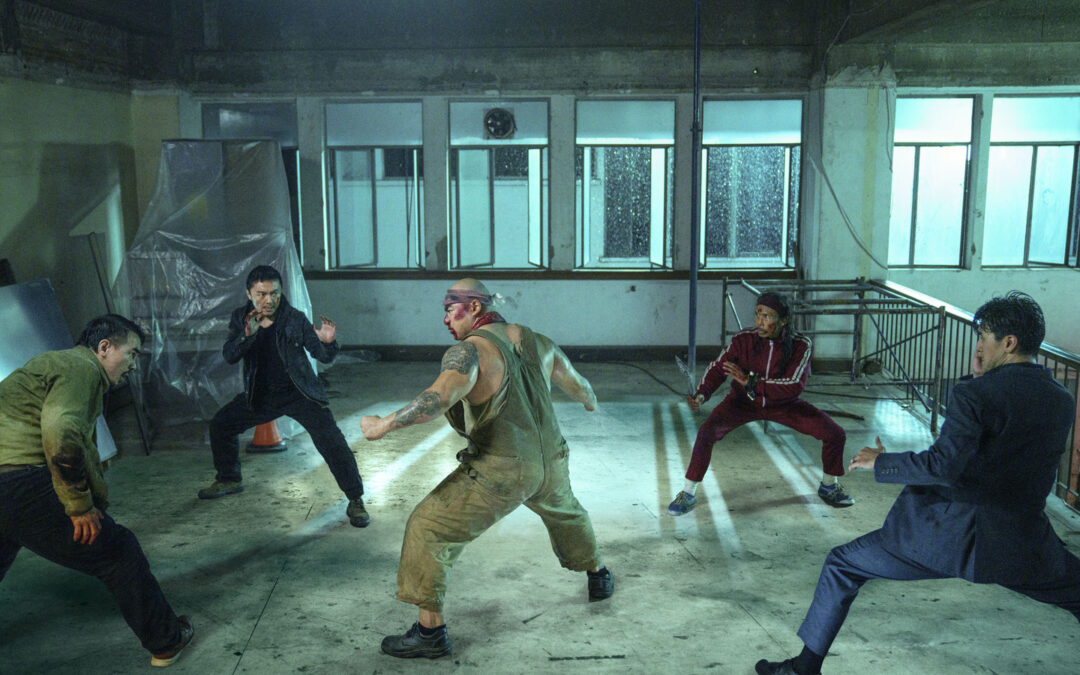
Wang and Navin will encounter Ho and Tak again as they close in on the kidnapping gang in a series of over-the-top fight scenes that include double-teaming Ho in an ice house as their opponent swings a lethal sledgehammer and a final showdown in a police station, as the duo take on their opponents in a breathtakingly epic battle that will ultimately sort out who dies and who survives, if indeed any of them can emerge from the conflict alive.
There’s not much more to the plot than Wang and Navin’s relentlessly determined attempt to rescue Rainy and locate Matia as they bash their way through a punishing series of fight sequences. While ostensibly set “somewhere in Southeast Asia,” the film was shot in Thailand and much of the supporting cast are Thai actors and stunt performers as well. Many scenes are dominated by English-language dialogue, much of it badly dubbed for the pan-Asian cast, but Wang is mute after suffering a traumatic head injury, so he communicates with sign language and hastily scribbled notes. While the four screenwriters credited on the film ignore an early opportunity to elevate the child-trafficking angle and Matia’s investigation, ultimately that’s not really the point of a movie dedicated to the muscular expression of male rage.
Tanigaki, action director Kensuke Sonomura, DP Meteor Cheung and editor Chris Tonick form a seamlessly cohesive team, maneuvering the actors into increasingly punishing and perilous combat scenes and fluidly swooping the camera around, beneath and over the performers, while assembling the shots for maximum kinetic impact.
The actors are the real attraction though, with Wang displaying an astounding range of extravagantly staged techniques and remarkable flexibility as he jumps, kicks, punches and head-butts his way through the baddies, often employing unexpected props, including a ball-peen hammer, a wooden pallet and even a bicycle, as improvised weapons. Taslim’s more economically deployed fighting style is an equally effective marvel of ruthlessness, as he pummels his opponents into submission. Ruhian and Le ferociously respond with equally threatening fight moves, as well as hand weapons wielded with lethal intent.
At the somewhat predictable and undeniably satisfying conclusion of The Furious, you’re unlikely to remember the flimsy character development and utilitarian dialogue so much as the dynamic execution of the movie’s premise that the determination and skill of two aggrieved family men can erase a grimy smudge of evildoers, at least for a brief interval.