
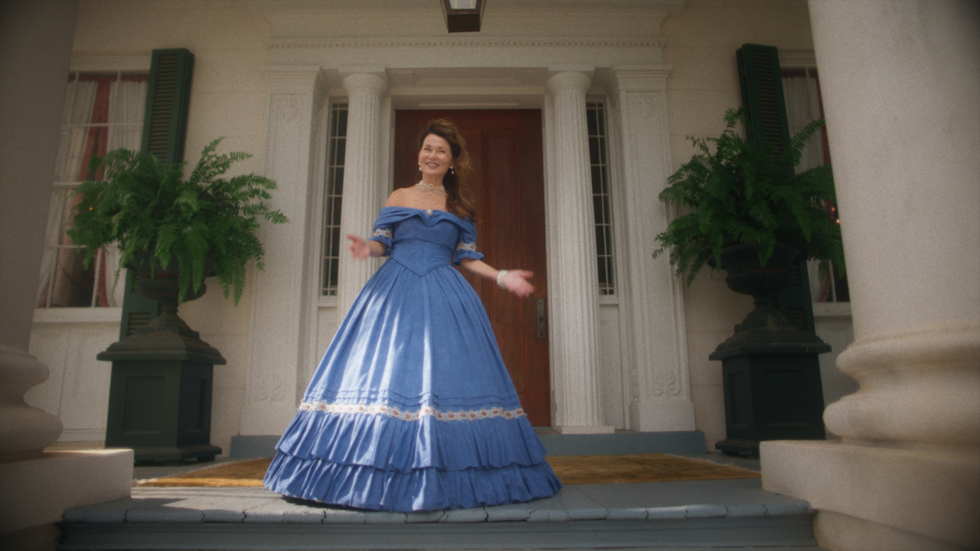
(Photo: © 2026 Oscilloscope Laboratories)
Oscilloscope Laboratories. 2026. Documentary. 86 mins.
RATING: 3.5 out of 4
You’re not going to see a more timely movie this year than “Natchez,” Suzanna Herbert’s often wry, ineffably saddening portrait of the American conversation around race and history. This ravishingly filmed and astutely edited documentary shows a community out of sync with itself — not only with its legacy as one of the fulcrums on which the American slave system once balanced, but also in more immediate and nuanced ways.
Documentaries are perhaps our most patient cinematic art form, and “Natchez” lives up to that tradition. Herbert and her ace cinematographer Noah Collier spent 100 days on site in Mississippi, filming for 75 of those. What they documented is a tussle between competing historical truths: the reality of Natchez as the second largest slave market of the antebellum South, a hellish portal through which 750,000 men women and children were sold into bondage; and the “Lost Cause” fantasy the whitefolk in places like Natchez have consoled themselves with for over 160 years. The latter narrative is familiar to anyone who ever watched the all-time movie blockbuster “Gone With the Wind,” which begins with a crawl, reading:
“There was a Land of Cavaliers and Cotton Fields called the Old South…
Here in this pretty world Gallantry took its last bow…
Here was the last ever to be seen of Knights and their Ladies Fair,” etc. Ad nauseum.
Because it prospered so mightily during the slave trade, Natchez is dotted with antebellum mansions Scarlet O’Hara could have proudly called home. But upkeep on these compounds is expensive, so their owners throw them open to the public for remarkably popular guided tours, mostly peopled by “Southern heritage” buffs.
There are four principle figures in this rich ensemble film, each of whose lives revolve around this historical tourist trade. “Rev” is Tracy Collins, a pastor and tour guide who drives his van to Natchez from over thirty miles away every workday in order to tell the story of a place that really was, where slaves were bartered like the cotton they picked, and everyday life was for many a series of rapes, tortures, and a thousand other indignities and horrors. Rev is compelled not only by a sense of duty to the dead, but because Natchez remains an epicenter of feelgood fairytale disinformation. On the tours Rev doesn’t give, slaves are referred to as “servants,” if they are even referred to at all.
A favorite of the locals is David Garner, a “Southern heritage” reactionary who owns with his husband an estate called “Choctaw,” which he presents as having passed down in his family for generations, though in fact it was purchased by the couple and refurbished beginning in 2014. Garner seems affable and harvests sympathy as he rather bravely guides tours around his estate despite advancing Parkinson’s, and we even feel admiration when he cosponsors a LGBTQ+ drag ball, in an unwelcoming town. But Rev is almost certain Garner gives his tours a little differently when his audiences are entirely white, and his suspicions prove sadly and even shockingly well-founded.
The hoop-skirted “belle” who greets and farewells Choctaw’s clientele is Tracy McCartney, a recent divorcee trying to stay chipper and upbeat in reduced circumstances. She has affection for her job and her boss, but she approaches the history of Natchez with an open mind, so much so that she befriends “Rev” in large part to understand his point of view.
Balancing out the portraiture is Deborah Cosey, the first Black member of the preservationist Pilgrimage Garden Club, who like Rev is ready to bring some hard truths into a longstanding Southern fantasy, even at the cost of excruciating encounters with the entrenched Southern heritage types who rule her group. Deborah bought a columned home in Natchez without knowing its provenance. When it turned out to have been the slave quarters on a plantation whose main house burned down, Deborah, like Rev, found herself with a sense of mission.
The dialogue between these amateur historians is by turns fascinating, moving and deeply upsetting. Watching “Natchez,” we worry about problems of communication throughout America that seem newly insoluble. And we also worry equally about what has happened to Natchez in the nearly four years since Herbert’s documentary was filmed. Do the park rangers dedicated to the truthful presentation of the Forks of the Road slave auction site still have jobs? Are the wide array of slave shackles Rev always starts his tour with even still on display? Who knows? But maybe not.
On the day it took office, the current Trump administration terminated all diversity, equity and inclusion initiatives, and instructed government agencies to expunge all “outward facing” DEI media within two days. By March 2025 government agencies were being asked to limit usage of 200 words or phrases, including “women,” “Tribal,” “disability,” and “race and ethnicity.” References to transgender protestors were removed from government materials related to the Stonewall National Monument, and references to the “LGBTQ+” community were reduced to “LGB.” The tribal name of Alaska’s Mt. Denali was reverted to Mt. McKinley.
This cascade of re-information climaxed in an executive order called “Restoring Truth and Sanity to American History,” wherein the White House banned what was depicted as narratives that “reconstruct [America’s legacy] as inherently racist, sexist, oppressive, or otherwise irredeemably flawed” because they “deepen societal divides and foster a sense of national shame.” Anything receiving public funding must instead be dedicated to “uplifting public monuments,” presumably even and perhaps especially those that lie to the public through sins of omission.
Read that “Gone With the Wind” crawl again. It’s certainly constructed to sound uplifting. And it’s a lie. Every syllable, except for the ones in the two words “Old South.”
There was a time not all that long ago when Americans shared a sense of certainty that the basic facts mattered and even a hope that some of the most harrowing aspects of our past were of settled importance. It is also not all that long ago that Barack Obama was elected president, and in some naive quarters a “post-racial” American society was confidently declared. “Natchez” shows how the struggle to interpret who we were as a way of understanding who we are has not ended and perhaps never will. But watching this film is listening to history, in the truest sense. “Natchez” is a luminous and solitary candle, sputtering brightly in a tempestuous moment of American darkness.