
(IMAGE: © 2025 SEARCHLIGHT PICTURES)
Searchlight Pictures. 2025. Comedy. 103 minutes.
RATING: 2 out of 4
Right from the opening sequence of mononymously named Japanese director Hikari’s new dramedy Rental Family, it’s clear that she’s signposting typical Tokyo locations to help orient international audiences with recognizable imagery: the iconic multidirectional Shibuya pedestrian crossing, the Kabukicho red-light district, cosplayers in full regalia, anime character street murals.
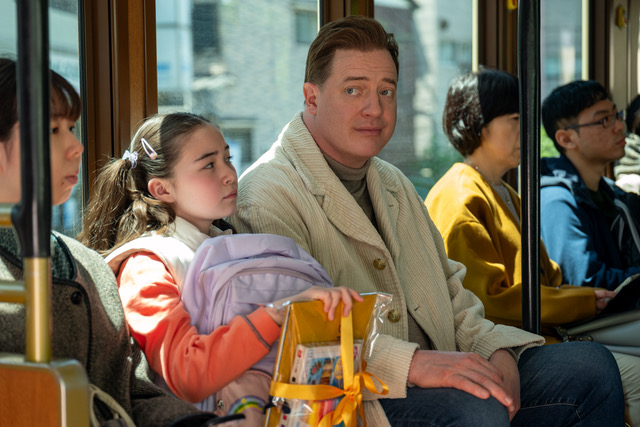
These shots help reassure viewers of their familiarity with contemporary Japan, a setup that the director quickly undercuts with an early scene of protagonist Phillip Vandarpleog (Fraser) rushing to catch the subway. Towering over other passengers, with his large frame occupying more than a single seat, Phillip looks out of place, an awkward, uncomfortable expression suggesting a certain level of innate anxiety.
Numerous similar scenes imply that Rental Family intends to reveal that we, like Phillip, may not really be that familiar with Japanese culture beyond certain stereotypical assumptions. However, rather than probing some of the complex characteristics that distinguish typical social expectations in Japan, Hikari glosses over the significant differences in perspective that frequently confound Phillip, instead offering weak platitudes concerning the universal search for belonging and shared connection.
Although it’s been seven years since Phillip arrived in Tokyo for a memorable appearance in a TV commercial that local residents still recall for starring a gaijin, or foreigner, he’s still lacking those connections, consistently fumbling his way through daily interactions with locals. The interval since that gig has not been kind to Phillip, who’s still rushing around town between auditions in a frequently frantic attempt to land a juicy role, or any role really. The opportunity that comes his way is completely unexpected however and involves playing the part of a “sad American” attending what’s revealed as a staged funeral service that features other actors praising the client, who acts as the “deceased,” for a life well-lived. After Phillip discovers that the ersatz ritual was arranged by a small, specialized talent agency, he accepts a job offer from owner Shinji Tada (Shogun’s Takehiro Hira). Known as “Rental Family,” the company provides stand-ins for clients’ important social occasions, offers companionship for lonely shut-ins, and fills longer-term roles for more complex assignments.
While the unfamiliar business model confuses Phillip no end, these types of agencies are widespread in Japan and although foreigners may find their services strange, or even distasteful, others see them as helping to mend and strengthen the country’s cultural fabric, as a well-documented epidemic of isolation and loneliness continues to take a toll on residents’ mental health. Companies like Rental Family can temporarily bridge the gaps between entrenched cultural expectations and mismatched individual circumstances with a friendly companion or a stand-in acquaintance.
As it turns out, Shinji needs a “token white guy” to fulfill customized client requests, landing Phillip a gig as fake Canadian groom “Brain Callahan,” for queer client Yoshie Ikeda (Misato Morita) so that she can provide her family with a convincing reason for secretly leaving the country with her girlfriend. On the wedding day, Phillip panics, attempting to bail on the traditional ceremony. After Rental Family staffer Aiko Nakajima (Monarch: Legacy of Monsters’ Mari Yamamoto) tracks him down, Phillip confronts her with his misgivings, telling her “It’s a lie. I’m messing with people’s lives.” Aiko counters that it’s actually an opportunity to make a difference for often-desperate clients, coaxing him to join Yoshie at the altar.
In reality, Phillip fundamentally fails to grasp that abandoning Yoshie would bring immeasurable shame upon both her and her family in a public setting where it would be impossible to escape social censure. After barely salvaging the staged wedding, Phillip accepts an assignment as “Kevin,” playing the long-absent American husband of Hitomi Kawasaki (Shino Shinozaki), a single mother who needs to project a stable family image to help her 11-year-old biracial daughter Mia (newcomer Shannon Mahina Gorman) complete the admissions process for an elite, inconveniently conservative private school. Another job finds Phillip taking on the guise of entertainment journalist “John Conway” for a series of “interviews” with elderly actor Kikuo Hasegawa (veteran movie and TV actor Akira Emoto), whose daughter Masami (Sei Matobu) fears that her father feels his acting career has been forgotten by the public and that retirement is accelerating his decline into dementia.
Each of these situations requires extensive preparation and considerable improvisation over several weeks as his interactions with clients frequently veer into unexpected emotional territory. The personal investment required begins to draw Phillip deeper into the lives of Mia, who literally needs to believe he’s actually her father in order to convincingly complete the school application process, and the neglected Kikuo as they gradually accept and eventually rely upon his integration into their lives. And while the consequences of intentionally deceiving a young girl may be somewhat foreseeable, the outcome of misleading an elderly man with memory loss comes as something completely unexpected for Phillip. Regardless, he grows increasingly attached to his new friends, even as Shinji and even his clients warn him not to become too involved. “You’re just a gaijin,” Aiko tells him at one point, “you will never understand how things work here.”
In her sophomore feature, Hikari attempts to bridge the distance between cultures and align the perspectives of distinctly different characters, with decidedly variable results. Her screenplay, co-written with Stephen Blahut, consistently falls back on convenient coincidence and easy sentimentality rather than grapple with unpacking the distinctions in cultural values that the film’s Japanese characters struggle to elucidate for Phillip. “You can live here a hundred years and still be left with more questions than answers,” Shinji tells him early on, rather than attempting to explain how, for instance, a frequent concern about maintaining appearances and prioritizing decorum might motivate clients to seek out Rental Family’s services. Instead, Shinji observes that “Mental health issues are stigmatized in this country, so people have to turn to other things,” as if every request for the agency’s assistance deals with an emotional crisis, rather than perhaps just a preference for a convenient solution.
Fraser seems to take it all in stride however, his character’s often-visible discomfort and outward nervousness manifested by facial expressions that vary between weak smiles and gentle frowns. When called upon, he speaks passable Japanese and has incorporated a variety of appropriate social cues into his performance, but overall most of his interactions with locals take place in English and few scenes really require him to stretch much to achieve a passable performance.
While it may be difficult not to view Rental Family from a perspective of missed opportunities, Hikari ultimately delivers a feel-good film that few will genuinely object to, even if they might have wished for a degree more insight than the movie offers.